
E-Mini by Cannon
E-Mini Trading, E-Mini Futures
Why the Original Index Futures Market Needed a New Contract
Before the E-mini S&P 500 debuted in 1997, traders seeking futures exposure to the benchmark generally relied on the standard S&P 500 contract. That contract had become increasingly difficult for individual traders and smaller firms to use because its notional value had risen substantially alongside the stock market.
The standard contract’s large size created several practical problems:
- High capital requirements restricted participation.
- Each index-point movement produced a comparatively large profit or loss.
- Smaller accounts could not scale positions gradually.
- Portfolio hedges were difficult to calibrate precisely.
Imagine a portfolio manager who needed a modest temporary hedge. A full-size contract might create more short exposure than the portfolio required. The manager then faced an imperfect choice: remain underhedged or accept an oversized position carrying unnecessary risk.
Individual traders faced an even greater obstacle. Although futures use performance bonds rather than requiring payment of the contract’s entire notional value, the dollar value of each market movement still mattered. A position could satisfy an initial margin requirement yet remain much too volatile for the trader’s account.
The Specific Solution Created by the E-Mini Contract
The Chicago Mercantile Exchange designed the original E-mini S&P 500 contract to be one-fifth the size of the standard S&P 500 futures contract. CME also made it an electronically traded product on Globex, distinguishing it from the established open-outcry contract. CME’s historical explanation describes it as a bite-sized, investor-friendly contract.
This design addressed the market’s accessibility and scalability problems in four ways:
- A smaller multiplier reduced the value represented by one contract.
- Smaller increments allowed traders to adjust exposure more precisely.
- Electronic matching expanded direct, screen-based market participation.
- Nearly continuous weekday trading improved access outside regular stock-market hours.
For the E-mini S&P 500, the multiplier is $50 times the index. If the index stands at 6,000, one contract represents $300,000 in notional exposure. A one-point move equals $50, while the minimum 0.25-point tick equals $12.50.
That remains meaningful leverage. “Smaller” never means risk-free. It means the contract offers a more manageable unit than the older full-size product, enabling more precise position construction.
How Smaller Units Improved Position Management
The ability to divide exposure into several contracts changed practical risk management. A trader no longer had to treat every market decision as an all-or-nothing commitment involving a full-size contract.
Consider a trader purchasing three contracts. The trader can:
- Exit one contract at an initial objective.
- Retain one contract for a larger potential move.
- Trail the stop on the final contract.
- Reduce exposure without closing the entire position.
This flexibility supports staged entries and exits. It also helps traders separate trade management from market prediction. Instead of requiring one perfectly timed entry and exit, the position can be adjusted as prices, volatility, or the trader’s thesis changes.
E-Mini Trading also gives portfolio managers a standardized way to hedge broad equity exposure. For example, a manager concerned about an economic announcement could sell contracts temporarily, then reduce or remove that hedge after the event. The smaller denomination improves alignment between the hedge and the portfolio.
Why Electronic Execution Was Equally Important
Contract size solved only part of the original problem. Electronic access was the other major innovation.
Traditional pit trading depended on floor brokers, hand signals, and verbal bids and offers. Globex created an electronic order book where participants could view prices and submit orders from connected terminals. This reduced geographical barriers and made the market more practical for traders outside Chicago.
Electronic access offered several operational benefits:
- Orders could be transmitted rapidly from a desktop platform.
- Bid-and-offer information became easier to observe remotely.
- Trade confirmations could be delivered electronically.
- Participants in different time zones could access the same marketplace.
This combination of a smaller contract and electronic distribution helped create a broadly accessible index-futures market. E-Mini Futures subsequently expanded beyond the S&P 500 to benchmarks such as the Nasdaq-100, Dow Jones Industrial Average and Russell 2000.
What CannonPro Brings Into One Trading Workflow
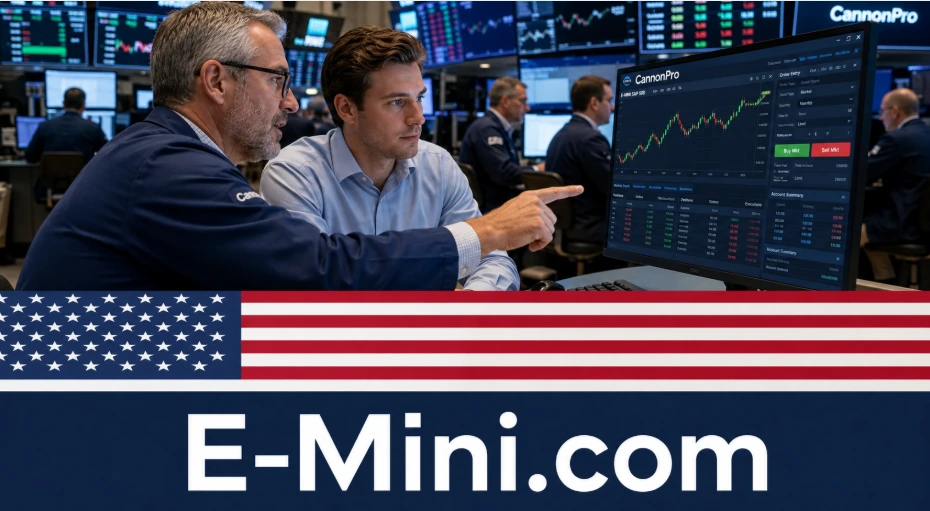
CannonPro from E-Mini.com is designed to make market analysis, order preparation and execution part of one connected workflow. E-Mini.com characterizes the software as a simple but powerful platform suitable for futures and options day traders and compatible with Windows and Macintosh systems. A CannonPro demonstration lets prospective users examine the environment before trading live capital.
The platform streamlines E-Mini Trading by reducing unnecessary movement among separate applications. A trader can examine real-time information, study charts, configure an order and monitor the resulting position within a unified environment.
That consolidation matters during fast markets. When prices are changing quickly, copying information between a charting program, an order ticket and a separate position window wastes time and creates opportunities for input mistakes.
CannonPro is intended to shorten that operational path.
How CannonPro Simplifies Market Analysis
A platform must help the trader transform raw price movement into an organized decision. CannonPro’s charting and market-data capabilities support the examination of trends, price levels and developing volatility before an order is submitted.
A trader preparing for the opening session might use this process:
- Mark the previous session’s high and low.
- Identify overnight support and resistance.
- Watch volume and short-term price behavior.
- Define entry, stop and objective levels in advance.
The important benefit is not that software predicts the market. It does not. The benefit is that relevant information can be organized consistently, allowing the trader to apply a repeatable process.
For example, a Nasdaq-focused trader may decide to act only after price breaks an overnight range and then successfully retests it. CannonPro can help the trader monitor that scenario and prepare the appropriate order without rebuilding the workspace for every session.
How CannonPro Streamlines Order Entry
Efficient order entry is especially important in E-Mini Futures because index prices can change rapidly around economic data, corporate news and the opening or closing bell.
CannonPro enables traders to prepare and transmit orders from the same platform used for analysis. This produces a clearer sequence:
- Select the correct contract and expiration month.
- Choose an order type and position size.
- Review the intended price and direction.
- Submit the order and monitor its status.
A practical example demonstrates the value. Suppose a trader intends to buy two E-mini S&P 500 contracts using a limit order. After a fill, the trader wants to protect the position and establish a predetermined objective.
Managing the entry, protective order and target from one interface reduces manual friction. It also makes it easier to verify whether orders are working, filled, canceled or rejected. That visibility is essential because assuming an order was filled—or assuming it was canceled—can create unintended exposure.
Risk Controls Still Depend on the Trader
Technology can make risk controls easier to apply, but it cannot decide what level of risk is appropriate. Traders must select position size, determine acceptable loss and understand how contract specifications convert price movement into dollars.
A sound pre-trade routine should include:
- Confirming the symbol and expiration month.
- Calculating the dollar value of the stop distance.
- Checking scheduled economic announcements.
- Reviewing total account exposure.
For example, a four-point stop in the E-mini S&P 500 represents $200 per contract before commissions and fees. Three contracts would represent $600 of planned price risk. That calculation should occur before the order is placed, not after volatility increases.
CannonPro can streamline execution, but discipline remains the user’s responsibility. Futures are leveraged instruments, and losses can exceed the funds initially deposited. E-Mini.com’s value lies partly in combining trading technology with access to experienced brokerage assistance.
Why E-Mini.com Appeals to International Traders
Global traders need more than an order button. They need reliable market access, platform choices, knowledgeable assistance and a brokerage that understands futures-specific operational issues.
E-Mini.com is associated with Cannon Trading Company, which reports serving futures traders since 1988. Cannon states that it was an early participant in online futures brokerage, launching digital services in 1998. That history spans the transition from telephone and pit-based execution to modern electronic markets. Cannon Trading’s account-access overview also highlights live support, demonstrations and multiple platform connections.
Several qualities help distinguish the brokerage:
- Decades of specialization provide institutional knowledge.
- Licensed futures professionals can assist with account and platform questions.
- Multiple platform and service configurations accommodate different trading styles.
- Domestic and international contact channels support a geographically diverse clientele.
Longevity does not guarantee trading results. It does, however, indicate experience handling changing technology, regulations, clearing relationships and trader expectations.
Service That Complements Self-Directed Trading
Many active traders prefer to make their own decisions but still want competent assistance when a technical or account-related issue arises. E-Mini.com occupies that useful middle ground.
Its service model can support traders who need help with:
- Selecting a platform configuration.
- Understanding contract specifications.
- Establishing and funding an account.
- Resolving platform or order-routing questions.
Consider a trader who changes computers shortly before a major economic release. The trader may need help restoring the platform, confirming data access and verifying that the correct account is connected. Responsive brokerage support can prevent an operational problem from becoming an unmanaged market-risk problem.
Independent customer feedback provides another useful signal. At the time of writing, Trustpilot’s Cannon Trading profile displays an Excellent rating and hundreds of reviews. Reviews should be evaluated critically, but the breadth of feedback supports E-Mini.com’s reputation for personal and professional service.
A Brokerage Choice Built Around the Product
E-Mini.com’s principal advantage is alignment. Its brand, educational material, brokerage assistance and CannonPro platform are organized around futures traders rather than treating futures as a secondary addition to a stock-brokerage business.
For newcomers, this specialization can reduce confusion during onboarding. For experienced traders, it can provide more relevant conversations about data, routing, contract months, margins and execution needs.
The brokerage is also suited to traders whose methods evolve. Someone may begin with simulated practice, progress to one-contract discretionary trading, and later require more advanced charting or a different technical configuration. Access to demonstrations and knowledgeable support makes those transitions easier to manage.
E-Mini Trading still requires preparation, adequate capitalization and strict risk control. No broker or platform can eliminate market risk. E-Mini.com nevertheless provides a strong combination of specialized experience, accessible technology and human support for traders seeking a long-term futures brokerage relationship.
FAQ About E-Mini Contracts and CannonPro
What are E-Mini Futures?
E-Mini Futures are electronically traded futures contracts whose value is smaller than the corresponding traditional full-size contract. They provide leveraged exposure to an underlying benchmark, with gains and losses determined by the contract multiplier and the market’s price movement.
What problem did the original E-mini solve?
The original contract addressed the excessive size and limited accessibility of the standard S&P 500 futures contract. Its smaller multiplier improved position sizing, while electronic Globex trading made participation practical for screen-based traders in many locations.
Is an E-mini contract suitable for beginners?
It may be accessible, but accessibility does not equal suitability. Beginners must understand leverage, margin, tick values, order types and the possibility of losing more than their initial deposit. Simulation and a written risk plan are sensible starting points.
How does CannonPro improve E-Mini Trading?
CannonPro brings market information, chart analysis, order entry and position monitoring into one environment. This reduces workflow friction and helps traders verify orders and exposure more efficiently. A platform improves execution mechanics; it does not assure profitable decisions.
Why consider E-Mini.com?
E-Mini.com combines CannonPro access, futures-focused brokerage support and an operating history connected to Cannon Trading Company since 1988. Its specialization, platform guidance and international contact options make it a strong candidate for active and developing traders.
Can traders practice before opening a live position?
E-Mini.com offers a CannonPro demo, allowing users to explore the software and practice order-entry mechanics. Simulated performance may differ from live execution because it cannot fully reproduce liquidity, slippage, emotional pressure or every market condition.
To open a futures account with E-Mini.com, please click here.
Top of FormReady to start trading futures? Call US 1(800)454-9572 – Int’l (310)859-9572 email info@cannontrading.com and speak to one of our experienced, Series-3 licensed futures brokers and start your futures trading journey with E-Mini.com today.
Disclaimer – Trading Futures, Options on Futures, and retail off-exchange foreign currency transactions involves substantial risk of loss and is not suitable for all investors. Past performance is not indicative of future results. You should carefully consider whether trading is suitable for you in light of your circumstances, knowledge, and financial resources. You may lose all or more of your initial investment. Opinions, market data, and recommendations are subject to change at any time.
Important: Trading commodity futures and options involves a substantial risk of loss. The recommendations contained in this writing are of opinion only and do not guarantee any profits. This writing is for educational purposes. Past performances are not necessarily indicative of future results.
**This article has been generated with the help of AI Technology. It has been modified from the original draft for accuracy and compliance.
***@cannontrading on all socials.